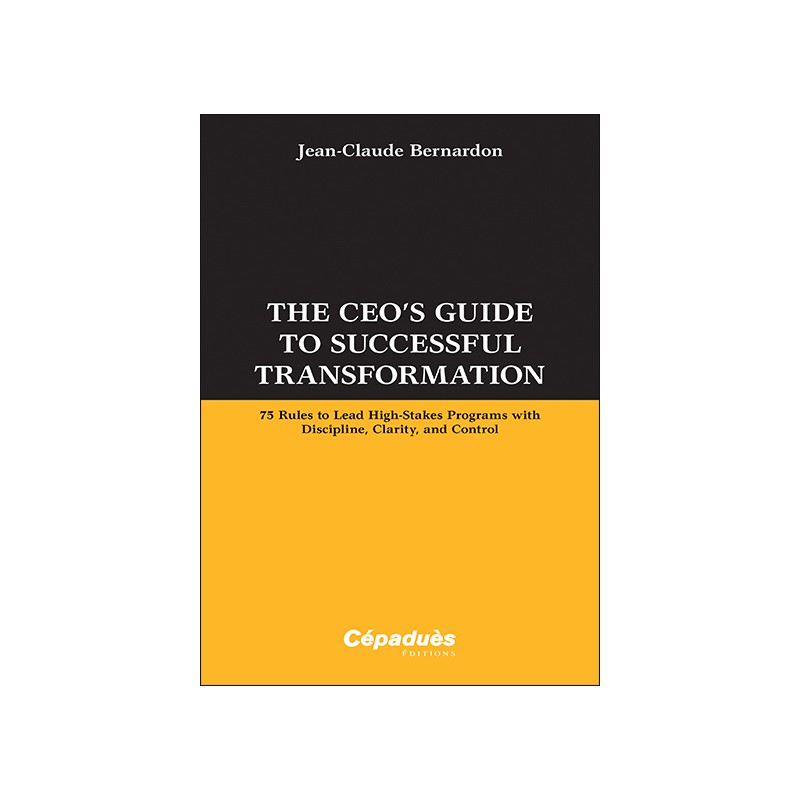
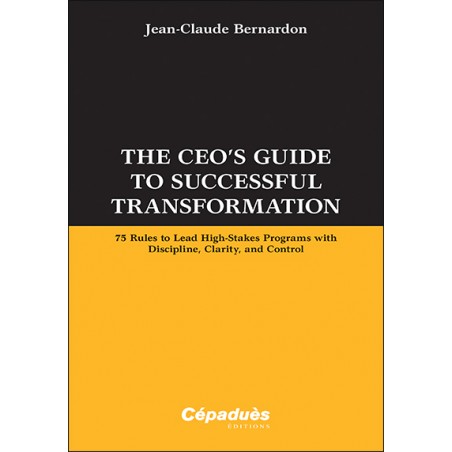


75 Rules to Lead High-Stakes Programs with Discipline, Clarity, and Control.

Commande avant 16h,
expédié le jour même (lu. - ve.)

Livraison express sous 48h.
Cet ouvrage est disponible en version numérique sur Apple Books.
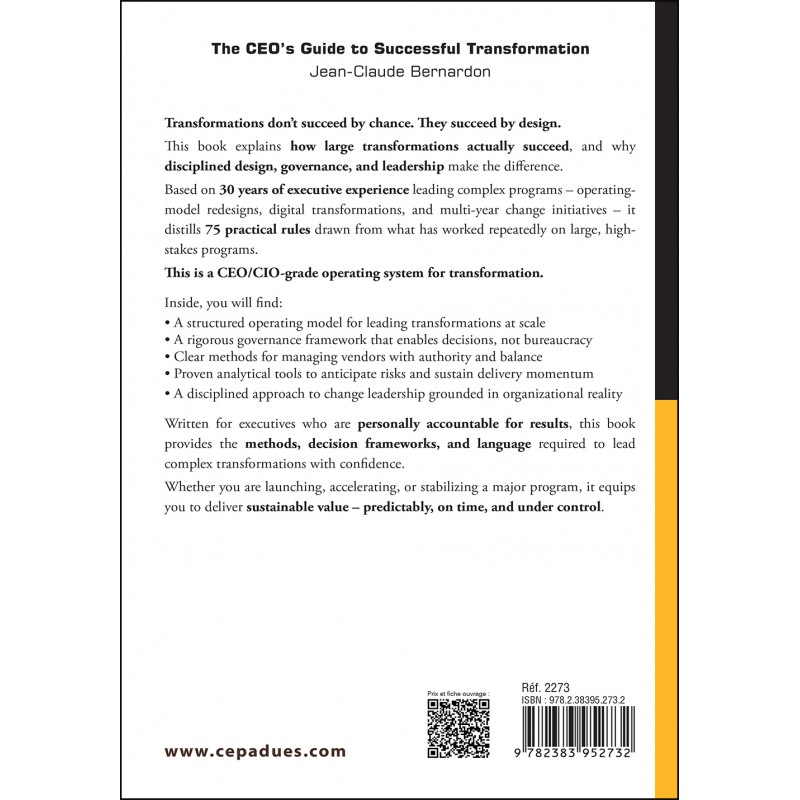
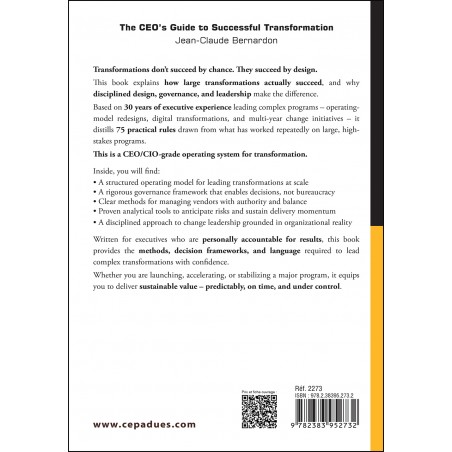
Transformations don’t succeed by chance. They succeed by design.
This book explains how large transformations actually succeed, and why disciplined design, governance, and leadership make the difference.
Based on 30 years of executive experience leading complex programs – operating-model redesigns, digital transformations, and multi-year change initiatives – it distills 75 practical rules drawn from what has worked repeatedly on large, high-stakes programs.
This is a CEO/CIO-grade operating system for transformation.
Inside, you will find:
• A structured operating model for leading transformations at scale
• A rigorous governance framework that enables decisions, not bureaucracy
• Clear methods for managing vendors with authority and balance
• Proven analytical tools to anticipate risks and sustain delivery momentum
• A disciplined approach to change leadership grounded in organizational reality
Written for executives who are personally accountable for results, this book provides the methods, decision frameworks, and language required to lead complex transformations with confidence.
Whether you are launching, accelerating, or stabilizing a major program, it equips you to deliver sustainable value – predictably, on time, and under control.
| Référence : | 2273 |
| Nombre de pages : | 242 |
| Format : | 16x24 cm |
| Reliure : | Broché |
| Rôle | |
|---|---|
| Bernardon Jean-Claude | Auteur |
Introduction
What This Book Will Do for You
How to Use This Book
Conventions Used in This Book
Framing the Program
How to Start in the Right Place
A Methodical Path to the Right Program
Ensuring Value for Money: The Essential Checks
How to Make the Program’s Purpose Emerge
Building on the Company’s Vision
Why Vision Is So Valuable for a Transformation Program
How to Articulate a Compelling Vision
1. Direct Formulation
2. Starting from Problems
3. Future “Key situations”
4. The 360° Method
Examples of Powerful Vision Statements
Define Your Target Operating Model
1. The Value Chain: Location and Outsourcing Choices
2. Designing New Processes
3. Anticipating Technology Needs
4. Organizational and Skills Implications
Demonstrate the validity of the business case
The “Direct Quantifiable Gains vs Program Cost” Method
The “Extended Gains vs Program Cost” Method
The “What-If-Not” Approach
The Benchmark Approach
Making the Business Case Self-Evident
Secure Executive Committee Commitment
Learn from Past Successes and Failures
Decode and Strengthen Your Program DNA
Time and Deadlines
Ways of Working
Productivity and Effectiveness
Culture
1. Working in Project Mode
2. Project Methodology
3. Meeting-Management Practices
4. Decision-Making Processes
5. Problem-Solving Methods
6. Personal Time and Priority Management
7. Collaborative Tools
Structure the Program into Projects
Business Projects vs IT Projects
Business Projects: From Current to Target Operating Model
IT Projects: From Legacy to Target IT
How to Find the Right Project Breakdown: A Three-Step Method
Final Consistency Check
Make Sure the Prerequisites Are Solid
Build Your Program Team
The Program-Management Team
Internal Business and IT Resources
The Operational Project Team
The Domain Leader
The Application Leader
Business Resources: Business Process Owners and Key Users
Business Process Owner (BPO)
Key User
Why This Model Works
Selection Criteria for Program Participation
1. Mastery of Their Functional or Technical Domain
2. Ability to Work in Project Mode
3. Acceptance of Program Constraints
4. True Operational Capability
5. Clear Expectations and Evaluation Criteria
How to Build and Engage the Team
Mutualizing Internal Resources at Program Level
Why Mutualization Matters
Launch the Program
The Company-Wide Kickoff Meeting
1. What
2. For Whom
3. Why
4. When
5. How
How to Deliver These Messages Effectively
The Program Team Kickoff
Negotiate and Select Your Partners
Structure the Vendor Selection Process
1. Company Overview
2. Context and Objectives of the RFP
3. RFP Rules and Procedures
a) Process and Timeline
b) RFP Contacts
c) Communication Protocol
d) Proposal Submission Rules
e) Selection Criteria
4. Program Overview
a) Objectives and Stakes
b) Scope
c) Major Milestones and Deadlines
5. Program and Project Governance
a) Program and Project Organization
b) Program and Project Governance Bodies
c) Reporting Framework & Expectations
d) Program PMQP
e) Project PMQP
f) Tooling Provided to the Integrator
6. Expected Solution
7. Technical Proposal
a) Description of Requested Services
b) Work Packages (WPs)
c) Workload Estimates
d) Methodology
e) RACI
f) Project Language
8. Structured Response Templates
9. Quality Assurance and Risk Management
10. Integrator Project Organization
11. Integrator References
12. Financial Offer
13. Contractual Aspects
RFI then RFP, or RFP Only ?
Two-Rounds RFP
Motivate Your Partners to Respond
Analyze Provider Proposals with Precision
Start by Framing the Analysis
Example: Work Packages for an ERP Project
Good Practices for Designing Work Packages
Analyze, Compare, and Optimize Proposals
How to Analyze and Compare Responses
How to Reach Optimized Offers
Negotiate the Important Points Early
Help Your Potential Partners Prepare for Your RFP
Conduct a Win–Win Negotiation
Do Not Compromise on Skills
1. Interview Key Candidates Before You Sign
2. Test Actual Competence Not Just Storytelling
3. Check References
4. Secure Key Resources in the Contract
5. Favor Full-Time Allocation on Major Projects
6. Refuse “Discount Resources” and Unrealistic Promises
7. Manage Subcontracting Carefully
Don’t Overlook Critical Clauses in Your Contract
Key Technical and Commercial Clauses
Daily Rates by Role and Location
Back-End Rebate
Travel Expenses
Stability of the Provider’s Key Resources
Declaration of Subcontracted Resources
On-Site Presence and the “3/4/5” Rule
Delay Penalties
Documented Effort-Estimation Method
Replacement of a Departing Consultant at the Provider’s Expense
Active Review of Deliverables
Productivity-Gain Clause
Vendor Quality-Assurance Services
Project Language
Access to the Information System
Time frame for integrating new partner resources
Follow-On Commitment
Termination Clause
Fixed-Price Commitments
Billing Schedule
Audit Rights
How Do You Make Sure You Haven’t Missed Anything ?
One-Page Contract Checklist for Transformation Programs
1. Pricing & Commercial Terms
2. Staffing & Resource Quality
3. Delivery Model & Governance
4. Scope, Deliverables & Quality
5. Risk Management
6. Future Flexibility
How to Use This Checklist
Legal Clauses
Obligation to achieve a result
Duty to Advise and Duty to Warn
Assignment of Intellectual Property Rights
Legal Compliance Warranty
Covenant of quiet enjoyment
Maintainability Warranty
Professional Liability Insurance
A Final Word
One-Page Essential Contract Clauses for a Systems Integration
Agreement
1. Obligation to achieve a result
2. Duty to Advise & Duty to Warn
3. Intellectual Property Assignment
4. Legal Compliance Warranty
5. Covenant of quiet enjoyment
6. Maintainability Warranty
7. Stability of Key Resources
8. Subcontracting Restrictions
9. Pricing Structure & Rate Protection
10. Travel & Expense Policy
11. Change of Resource Procedure
12. Deliverable Acceptance Process
13. Quality Assurance & Risk Management
14. Software Vendor Quality Review
15. Language Requirements
16. Information System Access Rules
17. Audit Rights
18. Termination Clause
19. Fixed-Price Commitments
20. Invoicing & Payment Schedule
Use a complete PMQP (Program / Project Management & Quality Plan) & RACI
PMQP structure & content
1. Purpose and Scope of the PMQP
2. Governance Model
3. Project Management Processes
4. Methodological Framework by Phase
5. Deliverable Catalogue
RACI Structure & content
Example RACI Extract (Simplified)
Pitfalls to Avoid
Negotiate the Price at the End
Be precise on every element of the commercial conditions
Daily rate by profile and location
Indexation and rate revisions
Back-end rebates on annual volume
Performance-based bonus / malus
Payment schedule
Lock commercial conditions for the duration of the program
Ask your provider for ideas to reduce the price
Flexibility on planning
Accept English as the working language
Increase offshore share
Adapt the working method without changing the end product
Shared resources
Lowering support SLAs
Pooling with other services
Sharing work with the provider
Productivity gain clause
Additional non-financial advantages
Sign all contractual documents
Leading the Program
Define Program Governance with Precision
Manage the Program Like an SME
As Program Director, You Are the CEO of This Enterprise
Equip Yourself with a Project Control Tower
Why do you need a PMO (Program Management Office) ?
What Should the PMO Do ?
1. Tool Selection and Administration
2. Operational Monitoring & Support to Internal Teams
3. Reporting Analysis
4. Risk Management
Sizing and Positioning the PMO
Deploy High-Performance Management Tools
Enforce Rigorous Financial Management
Manage External Spend with Discipline
Keep Control
1. Start with a solid framework and stick to it
2. Automate as many processes as possible
3. Be exemplary in applying the PMQP
4. Do not tolerate “bad habits” at the start
Make the PMQP non-negotiable
Make RIDAs and active deliverable reviews part of the operating system
Own your KPIs and your planning
Focus Your Energy on What Matters
The 21 Ps of Performance
1. Produce
2. Predict
3. Plan
4. Publish
5. PMQP
6. Pertinent
7. Productive
8. Performing
9. People
10. Precise
11. Promote
12. Pay
13. Ponder
14. Persuasive
15. Pragmatic
16. Professional
17. Polite
18. Prudent
19. Punctual
20. Peaceful
21. Patient
Have Productive, High-Impact Working Days
Keep a Daily and Weekly To-Do List
Clear Your Email Inbox Every Day
Review Project KPIs and Daily Output
Don’t Procrastinate
Return Calls Every Day
Take Care of Yourself
“Eat the Frog”
Prioritize by Importance and Urgency
Schedule 45-Minute Meetings, Not One-Hour Meetings
Don’t Underinvest in Support Functions
Make Sure You Capture the Program’s Expected Value
During the Build Phase
1. Delays and Extra Budget Requests from the Provider
2. Change Requests
3. Requests for Extra Headcount (Especially Externals)
During Operational Run
Build the Solution
Don’t Skip Critical Stages
Identify the Right Business Needs and Eliminate the Rest
What Should the Company Do ?
How to Draft the Needs Before Working with the Integrator
What Will the Integrator Do with This Material ?
Find the Best Innovations
Three Principles for Innovation
Three Practical Methods to Generate Innovation
Method 1 – Start from Performance Objectives
Method 2 – Search for Ideas, Then Select the Best Ones
Method 3 – Starting from Problems
Build and Manage a Robust Requirements Repository
A 3-Level Process Structure
The Structure of the Requirements Repository
From Needs to Solution and Back
Enriching the Requirements Repository
Choose the Right Technologies
What is a Vendor RFI For ?
Proof of Technology (POT)
Proof of Concept (POC)
Avoid Misunderstandings with Your Integrator
1. Build a Shared Glossary
2. Show the Existing Applications and the Reality on the Ground
3. Share a Written Business Needs Document Upfront
4. Run Well-Prepared Design Workshops
5. Use the PMQP Review to Align on Deliverables
6. Take Real-Time Workshop Notes and Validate Them Before Leaving the Room
7. Replace “Validation by Default” with Active Reviews
8. Make the Solution Concrete Early and Often
9. Involve Business and IT Users in Testing
10. Use Business Simulation, Pilot Sites and Parallel Runs
Make Sure You Have Designed the Best Solution
1. Go Back to the Core Triangle: Purpose, KPIs, Business Case
2. Apply Project Management Best Practices Strictly
Testing Is Not Optional
Essential Recommendations
1. Train Your Teams on Proper Testing Methodology
2. Use a Test Management Tool
3. Accept No Compromise on UAT Quality
4. Formalize Acceptance in a Signed UAT Report
5. Consider External Testing Specialists, But Stay Involved
Testing Readiness Checklist
1. Governance & Scope
2. Organisation & Roles
3. Tools & Assets
4. Environments
5. Data & Migration
6. Readiness Controls Before Each Test Phase
7. KPIs & Reporting
8. Risk Management
Deploying the Solution
Do Not Skip a Serious Go-Live Strategy Assessment
What Is the Objective of a Deployment Strategy ?
The Main Deployment Strategies
Illustrative Examples
What to Analyze When Defining a Go-Live Strategy
A Proven Working Method
Timing: When to Address Go-Live Strategy ?
If Big Bang Is the Only Viable Option
Deployment Strategy check list
1. Clarify Strategic Objectives
2. Assess Organisational & Operational Context
3. Evaluate Core Go-Live Scenarios
4. Deep-Dive on Risk
5. Strengthen the Evidence Base
7. Run a Cross-Functional Decision Process
8. Plan the Transition & Cut-Over
9. Final Validation Before Commitment
10. Document and Communicate
Industrialize the Deployment Process
Data Cleansing
A few good practices
Data Migration
A few good practices
Cut-Over
Training
What the Deployment Network Must Do to Prepare Go-Live
Don’t Overlook the Post–Go-Live Phase
Managing Projects
Define Your Delivery Methodology and Deliverables Precisely
Document Your Project Management Processes Rigorously
Build the Project Schedule Under Resource and Cycle Constraints
Which Schedules and for What Purpose ?
The Global Program and Project Schedule
The Detailed Project Schedule
What a Load–Capacity–Constrained Schedule Enables
Practical Tips for Simple and Effective Schedule Management
Steer Project Progress Through Deliverables
Track Resource Onboarding and Offboarding Precisely
Manage Change with Discipline
Put in Place a Robust Deliverable Handover and Validation Process
Structure the Sign-off of Gates Rigorously
Identify and Control Risks
Establish Effective Project Rituals
Practice Corporate Frugality
Aim for High Collective Performance
Keeping the Project Schedule on Track
Planning and Running Working Sessions
Controlling Scope and Budget
Make Business and IT Work Effectively Together
Step 1: Leadership Alignment
Step 2: Organization and Governance
Step 3: Training on the Working Method
Step 4: Building a Shared Culture
Help Your Suppliers Be More Productive and Effective
Protect the Confidentiality of Project Information
Protecting Your Offices
Protecting Your IT Environment
Protecting Your Intellectual Property
Apply Security Rules in Public Spaces
Know When and How to Stop a Project
Protect and Develop Your Human Capital
Train Your People to Work in Project Mode
Find and Retain the Best External Resources
The Current Market Situation
Hiring Resources Provided by a Vendor
Hiring Freelancers
Attract and Retain Strong Internal Talent
Plan the Post-Project Role for Internal Resources
Monitor the Workload / Capacity Balance in Your Program
Leading Change
Introduce Change with Discipline
Analyze How the Program Impacts Employees
Analyze the Change Equation for Each Population
Build the Change Strategy
1. Validate the Understanding of the Change
2. Adjust Mental Models (Reason) and the Perception of Power
3. Amend the Change Without Altering the Vision and the Objectives
4. Emphasize the urgency of the change
5. Reassure Employees About the Support System
A Special Point of Attention: Rational Anticipations
Communicate and Listen
Managing a Conflict with a Vendor
Always Try to Resolve the Dispute Amicably First
How Do You Successfully Exit a Dispute ?
Embed Issue and Dispute-Resolution Processes in the PMQP
1. The Escalation Process
2. Crisis Management
3. The Project Audit
Maintain a Log of Issues & Apply the Procedures
Keep Your Teams Informed and Protect Them
Seek a High-Ground Exit
Prepare Yourself Thoroughly
Establish Working Sessions and Rituals
10 Rules for Managing Vendor Disputes
10 Red Flags That Signal a Vendor Relationship Is About to Go Wrong
Final Advice Before You Depart
Glossary
Index
Livres de l'auteur Jean-Claude Bernardon